.svg)


Flooring Questions
Answered
The Basics About Brazil Floors

We install unfinished and prefinished hardwood, engineered hardwood, luxury vinyl plank and laminate. We also sand, stain and refinish wood floors, repair damaged boards, redo stairs and put in molding.
Yes. We bring samples to your home, you pick the floor, and our own crew installs it. Buying the material and the labor from us is how you save up to 30 percent.
Connecticut, Massachusetts, Rhode Island, New Jersey and New York. Not sure we reach your town, send us a text with your zip code.
Our own installers and sanders. We don't hand your job to a crew we met that week.
Yes. Brazil Floors is licensed in every state we work in and fully insured.
Yes. We do all of our services for commercial spaces too, like stores, offices and restaurants. Hardwood, vinyl plank, laminate, sanding, refinishing, stairs and molding, the same work we do in homes.
Not right now. We work with hardwood, vinyl plank and laminate, plus sanding, refinishing, repairs, stairs and molding.
Yes. During the visit we help you pick the color, board width and layout, with the samples right there in your rooms.
We stop and show you. A soft subfloor, moisture or rot gets explained with the options and the price, and nothing extra happens until you say yes.
Yes. We vacuum, sweep and haul away the old flooring and the scraps before we leave.
Booking Your Free Estimate
Yes. We come to your home the next day with samples, measure every room and leave you a written price. No charge and no pressure.
Book online, call 800-909-0730 or send us a text. We'll be at your home the next day.
Nothing special. Tell us which rooms and what kind of floor you're thinking about, and we measure everything at the visit.
Photos help us talk it through, but the real price comes from the visit, because we measure every room and check the subfloor.
Just tell us. We update the written price before any work starts.
Text or call us and we'll move it. Please don't book a second time online, so we don't end up with two visits.
We text you the day before, around 4 PM, once the next day's schedule is set. On the day of the job, we text you again about an hour before the crew gets there.
It helps. That way everyone sees the samples in your own rooms, under your own light, and you can decide together.
No job is too small for us. For sanding and installation, though, we have a minimum charge equal to 500 square feet. That's what it costs us to send out a two person crew with a van and materials.
Yes. Whoever books the job and pays for it is our customer, and we take it from there.
Yes. Tell us about work hours, elevator use or any paperwork your building needs before the job, so we can plan for it.
Yes. We carry workers' compensation, commercial auto insurance and liability coverage up to $5 million, and we can send your building or HOA a certificate of insurance.
Before and During the Job
The day after you approve the estimate. For refinishing, the crew starts sanding that next day. For new flooring, that first day is delivery: the flooring sits in your home for 3 days to acclimate, then we install it.
Flooring takes on moisture from the air. Leaving it in your home for 3 days lets it adjust to your temperature and humidity, so it doesn't shrink or swell after it's down.
No. We just need a way into the house, the first payment when we start and the final payment when we finish. If you can set that up ahead of time, you don't need to be there.
Take small items, rugs, wall hangings and anything fragile out of the rooms. If there's big furniture, tell us during the visit and we'll talk about how to handle it.
We cover doorways and nearby surfaces with plastic and blue painter's tape before we start, and we work carefully around walls, cabinets and furniture.
You have our office and a project manager who visits the job from start to finish, so there's always someone who knows your floor.
Yes, when it needs to come out. Some floors can go right over what's there, and we'll tell you which during the visit.
Keep them in a closed room or out of the house while we work. Doors stay open, tools are everywhere, and fresh finish doesn't mix with paws.
Yes. Where hardwood or vinyl meets tile, carpet or another room, we put in a matching threshold or reducer so the edge is safe and clean.
Pricing and Payment
Installing unfinished hardwood is $2.00 per square foot and prefinished is $2.25. If you buy the wood from us too, our unfinished hardwood package is $5.50 per square foot and prefinished is $6.00, material and installation included.
$2.25 per square foot. That covers sanding to bare wood, your stain color and three coats of polyurethane.
Installation is $2.00 per square foot. Our luxury vinyl plank package, with material and installation, is $5.00 per square foot.
By the step. Installing new treads is $60 per step, and sanding and refinishing is a flat $50 per step.
Yes. Buy it wherever you like and we'll install it. Our labor price is the same if the flooring comes from us or from another store.
Stairs, raised thresholds, subfloor repairs, taking out the old floor and the board width you pick. We check all of it during the visit, so the written price is the one you pay.
Your price doesn't expire. Call us today or a year from now and we'll honor the number on your estimate.
Yes. Bigger jobs, like a whole floor or the entire house, get a volume discount, and you'll see it on your written estimate.
Yes. Show us a written quote for the same work and we'll match it or beat it.
Yes. Book online and you get $250 off.
Ask us during your free estimate and we'll go over the payment options for your project.
No. We don't take any money before the work starts. Flooring we already have on hand is paid for when we deliver it. Installation is paid when our crew arrives at your home to start. For sanding, staining and refinishing, you pay half when the crew arrives to begin and the other half when they're putting on the final coat.
We take cash, checks, Venmo, Zelle and Cash App.
Hardwood Installation
Unfinished boards are sanded and stained in your home, so you get the exact color and a smooth, sealed surface. Prefinished boards come coated from the factory, go in faster and you can walk on them the same day.
Solid hardwood can be sanded and refinished many times over its life. Engineered hardwood has a real wood top over a stable core, so it handles humidity better and works over concrete and in finished basements.
Red and white oak are the most common and wear well. Maple and hickory are harder and a good fit for busy homes. We bring samples so you can feel the difference.
Yes. We lay herringbone, chevron and diagonal floors, plus custom border designs. Send us a photo of what you like and we'll price it during the visit.
Yes, with the right choices. Harder woods like hickory and maple, a matte or satin finish and a lighter color all hide scratches better. If spills and accidents happen every day, vinyl plank may suit you better.
Full bathrooms, laundry rooms and most basements, where water and humidity can make it cup or swell. Waterproof vinyl plank is the safer pick there.
Vinyl plank is the safest bet because it's waterproof. Hardwood works too if you wipe up spills fast and keep a mat by the sink.
Most installations under 2,000 square feet are done in one day. Bigger homes, subfloor repairs or unfinished wood that still needs sanding and coats can add time, and we'll give you the schedule during the visit.
Decades, with basic care. Solid hardwood can be sanded and refinished several times over its life.
Yes. Solid hardwood can be refinished many times. Engineered hardwood can usually be refinished once or twice, depending on how thick the top layer is.
Buyers look for it. Real wood floors are one of the things people notice first in a listing and at a showing.
Seasons and Your Home
Heat dries the air, and the boards shrink a little, so thin gaps open between them. In humid summer months the wood swells back and the gaps close. Keeping indoor humidity between 35 and 55 percent with a humidifier keeps that movement small.
When the edges of the boards sit higher than the centers, moisture is coming from below, usually a damp basement, a crawl space or a leak. Fix the moisture first. Sanding a cupped floor too soon can leave it crowned once it dries out.
Yes. With the windows closed and the heat on, the air is dry and the finish cures well. Summer humidity is what slows it down.
Engineered hardwood and vinyl plank are the safer choices over radiant heat, because they move less as the floor warms and cools. We'll look at your system during the visit.
Engineered hardwood or vinyl plank. Homes near the coast see bigger humidity swings, and engineered boards move a lot less than solid ones.
Refinishing, Sanding and Staining
If the boards are solid and there's enough wood left above the tongue, refinishing is almost always cheaper. Deep water damage, rot or floors sanded too many times are when replacing makes more sense. We'll tell you honestly which one you have.
Sanding, the way we use it, is for new raw floors that just went in. Refinishing is for floors you already live on: we take off the old finish, fix what's loose and put on new stain and coats.
For floors under 1,500 square feet, a natural color with oil based or water based polyurethane takes 3 days. A stained floor takes 4 days. We always ask you to plan one extra day so nothing catches you off guard, which means 5 days is a safe plan for any job under 1,500 square feet.
Stay off the floor for 24 hours after the final coat. Furniture can go back 48 hours after the final coat.
Our sanding equipment pulls the dust into a vacuum as it works, so most of it never reaches the air. When the sanding is done, we blow down the walls and ceiling, then vacuum and clean everything before any coat goes on. From the first day to the last, we keep your home as clean as we can.
Most people stay in another part of the house while we sand. After the final coat, you'll need to stay off those rooms for 24 hours. If anyone at home is sensitive to smells, water based polyurethane has much less odor than oil based.
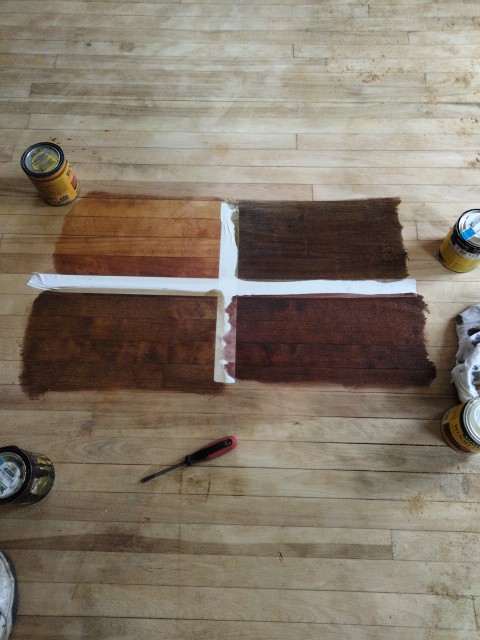
Yes. We make stain samples right on your floor, so you can pick the color you like best before we stain the room.
Water based dries faster, has less smell and stays clear. Oil based gives the wood a warmer amber tone. Both last when they're cared for.
Matte hides scratches and dust the best. Satin has a soft shine and is the most common pick. Gloss looks rich but shows every scratch and footprint.
Light gray stains usually sand out. Dark black stains have soaked deep into the wood, and those boards often need to be cut out and replaced.
No. Squeaks come from loose boards or the subfloor underneath, not the surface. We'll point out what's causing them during the visit.
When the finish is dull but the wood isn't scratched through, a light buff and a fresh coat can be enough. It costs less than a full sanding.
Most floors go many years between refinishings. Pets, kids and busy hallways shorten that. When the finish wears through to gray wood, it's time.
You can rent a sander, but it's easy to leave dips and swirl marks that only a full sanding can fix. Most people who try it end up paying twice.
Floor Repair
Yes. We cut out the damaged boards, weave in matching wood, then sand and finish the area so it blends with the rest.
We test stain on the new boards until it matches. On very old floors a perfect match isn't always possible, and we'll tell you before we start.
Stain markers and wax sticks hide light scratches for a while. Deep gouges, gaps between boards or gray worn spots need sanding to really go away.
Luxury Vinyl Plank
The planks we install are waterproof, which is why they work in kitchens, basements, laundry rooms and baths.
Often, if the old floor is flat and solid. Never over carpet. We check during the visit.
Yes, as long as the slab is flat and dry. We check the moisture and level low spots before the planks go down.
Yes, and plenty of people do it for one continuous look from room to room.
Often, yes, if there are spare planks from the same batch. That's a good reason to keep a box after the install.
It depends on the product. Some vinyl plank goes over an underlayment that softens sound and handles small dips. We'll tell you if yours needs one.
Yes, but skip rubber backed mats. They can stain the floor and trap moisture underneath.
Click planks look simple, but an uneven subfloor shows up later as gaps and soft spots. Getting the floor flat first is where most of the work is.
Laminate Flooring
Laminate installation is $2.00 per square foot.
Laminate has a wood based core with a hard top layer, so it resists scratches but doesn't like standing water. Vinyl plank is fully waterproof. In dry rooms both work. In wet rooms, go with vinyl.
Hardwood is real wood and can be refinished for decades. Laminate costs less and resists scratches better, but once it's worn it gets replaced, not sanded.
Living rooms, bedrooms, hallways, dining rooms and finished basements. Water resistant lines handle kitchen spills too, but for full bathrooms and laundry rooms we'd steer you to vinyl plank.
The planks click together and float over the subfloor, with no nails or glue. We lay an underlayment first and leave a small gap at the walls so the floor can move, then cover it with molding.
It looks like wood for less money, has a hard top that stands up to pets and kids, and goes in fast. Most single rooms are done the same day.
Standing water can swell it, and it can't be sanded or refinished like hardwood. A badly damaged plank gets replaced instead.
It's a durability rating for the top layer. AC4 holds up to busy homes, kids and pets, which is why we suggest it for most houses.
Often, if the old floor is flat and solid, like vinyl or old hardwood. Not over carpet. We check during the visit.
Yes, with matching nosing on each step. Hardwood treads last longer and can be sanded later, so we'll show you both.
Usually. A badly chipped plank can be swapped out without redoing the floor, as long as matching planks are available. Small scratches can be filled.
You can, but it's less forgiving than it looks. An uneven subfloor or bad cuts at doorways show up as gaps and bouncy spots. We check the floor for flatness first, which is where most do it yourself jobs go wrong.
Stairs and Molding
Yes. We pull the carpet, remove the tack strips and install new hardwood treads and risers cut to fit each step.
Hardwood treads. They hold up to traffic, match your floors and can be sanded again years from now.
Usually you'll want new shoe molding or quarter round to cover the gap at the walls. If the baseboards are damaged or the new floor sits at a different height, new baseboards make sense.
Warranty and Care
Our labor is covered for one year. New flooring also keeps the manufacturer's warranty.
Normal wear, accidents, pet damage and problems from poor care or leaks after the job. Defects in the material itself go through the manufacturer's warranty, and we'll help you with that claim.
Text or call us, tell us what you're seeing, and we'll come take a look.
Almost any floor can fade in strong direct sun, wood included. Shades or curtains on bright windows help a lot.
On hardwood, sweep or vacuum often, use a cleaner made for finished wood, skip steam mops and put felt pads under furniture. On vinyl plank, a damp mop with a mild cleaner is all you need. On laminate, use a barely damp mop and wipe up spills fast.
